Use the search engine below to find a specific content.
Technical Item 2020
Required competencies of Veterinary Services in the context of international trade: opportunities and challenges
(2020 Technical Item)
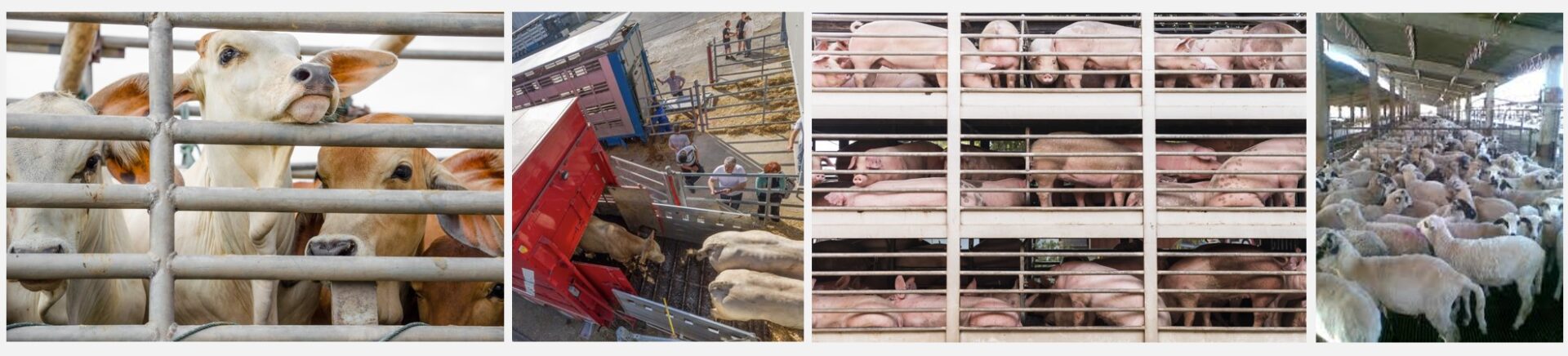
Veterinary Services are essential to safeguard animal health and welfare and veterinary public health at national level. They are the basis for sanitary certification of animals and animal products intended for trade. The private sector, including farmers and industry, play an important role in partnership with Veterinary Services.
However, with globalisation placing increasing importance on animal health measures, many countries cannot access international markets as they are unable to control or eradicate important diseases that have an impact on trade. Better access to markets for all countries will only be possible through appropriate investments in Veterinary Services. Many plans to produce and/or export animal or animal products from developing countries have been thwarted by a lack of confidence in national Veterinary Services to provide the necessary official health certification and related ongoing sanitary assurances. Trust among trading partners is crucial throughout the entire trade process to support and sustain export markets.
Compliance with OIE Standards relating to trade and to the effective control of animal diseases in these countries would therefore assist them to access international markets, using the global trade system to effectively advance their national interests, in particular in terms of economic growth and poverty reduction. The OIE is currently reforming and strengthening its training system to better accompany its Members in the implementation of OIE Standards.
The OIE 2020 Technical Item report provides rich information summarising international trade regulatory framework and their implications for Veterinary Services currently engaged in or aspiring to expand activities supporting trade. An analytical framework is constructed, sources of intelligence identified, evidence gathered and prepared for analysis, and analytical findings used to develop recommendations that will improve delivery of programmes for the benefit of OIE Members.
Foreword by OIE Director General, Dr Monique EloitVideo by the Chairperson of the Committee on World Food Security, Dr Thanawat Tiensin
Note: French and Spanish versions will be made available as soon as possible
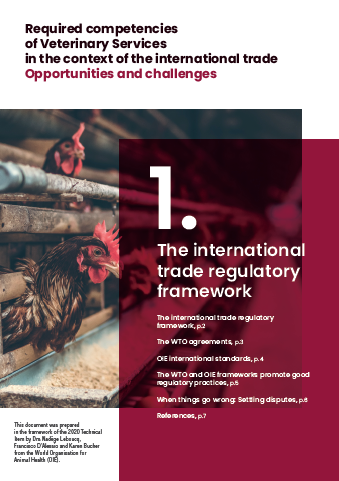 Technical Item Report
The Report is composed of five distinct parts – which can be used as stand-alone documents. Each of them is presented with associated resources, which all together intend to assist OIE Members to better implement OIE standards and secure international trade of animals and their products.
| PART I – The international trade regulatory framework | PART II – Role of Veterinary Services in international trade |
The World Trade Organization (WTO) Agreements and OIE international standards provide the framework to facilitate the negotiation between exporting and importing countries and to agree on the sanitary requirements to be applied in trade of live animal and animal products.
| There might be as many ways to organise the process to define the conditions for trade between countries as there are country-country interactions. Still, the role and meaningfulness of Veterinary Services in this process are in essence the same despite the procedural differences.
|
| PART III – Challenges faced by Veterinary Services in the context of international trade and examples of successful practices | PART IV – Veterinary Services’ competencies to secure and facilitate international trade, and PART V – OIE capacity-building activities to reinforce VS capacity on trade |
An analysis of PVS reports and other data sources (OIE Official status, self-declaration, WTO SPS Committee) was performed to identify key challenges faced by Veterinary services in the context of international trade as well as successful practices.
| On the occasion of this Trade Competence Package development, new concepts will be tested, such as the organisation of trainings by country typology (instead of by region), the creation of an OIE Trade Focal Point, or the elaboration of a wide range of e-modules
Additional OIE Resources |
 Your opinion matters to us!
We would like to hear from you with any questions, remarks and suggestions you may have on the Report; they can concern any matters including topics that were not sufficiently treated or the proposals made regarding future OIE capacity-building activities on trade presented in Part V.
Please share your views using the Forum dedicated to the 2020 Technical Item.
—–
*** Data analytics application developed with the support of